
Prologue
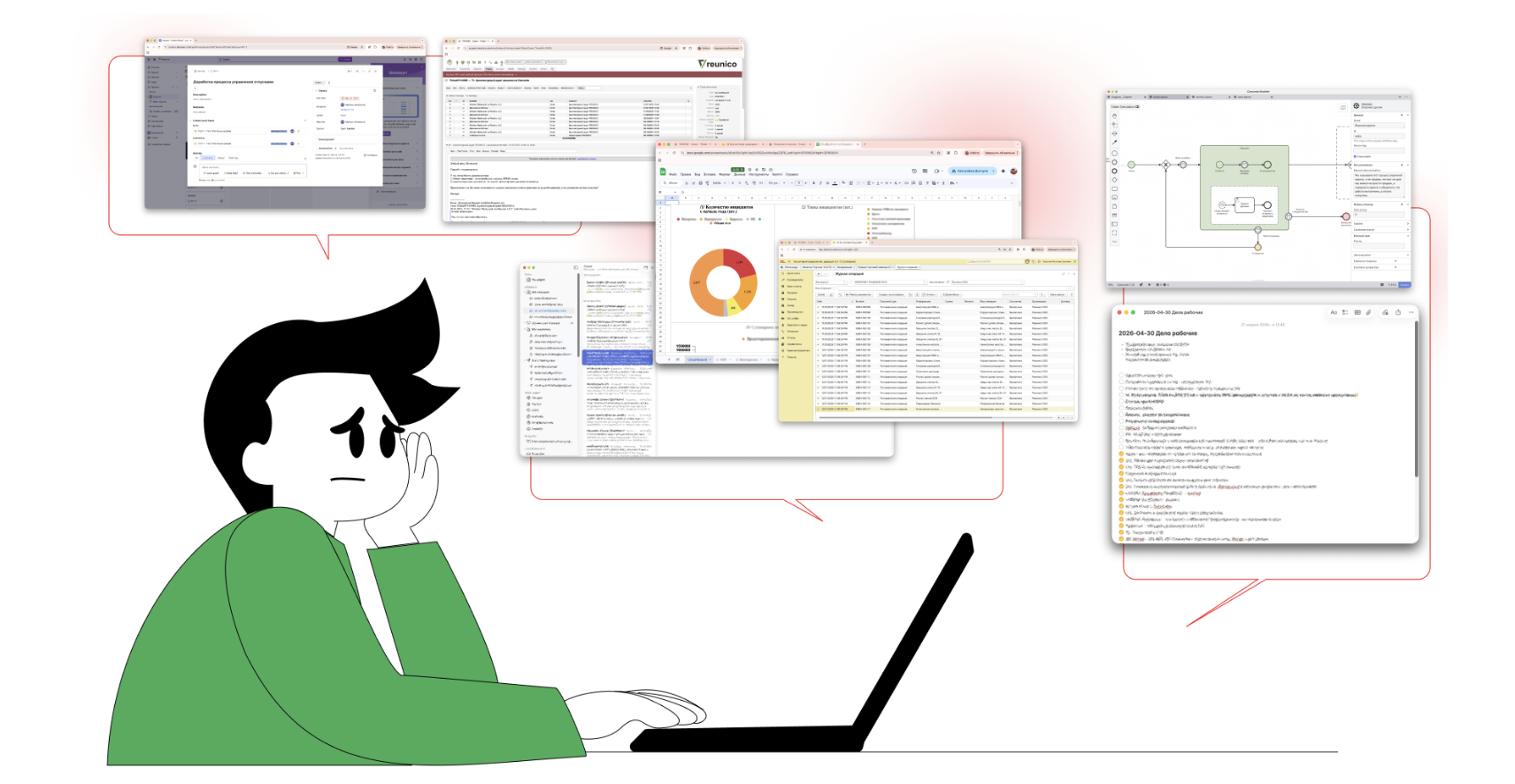
- “You don’t have automation — you have a mess of systems.”
I heard this a few years ago — not from a developer or an analyst, but from a junior manager.
My first reaction was irritation: “Are you serious?”
Then I stopped and thought about it.
We’re a relatively small company building custom platform solutions for B2B clients. Like any business, we have both core production processes and a wide range of supporting ones: customer support, sales, HR, approvals, contract management, and more.
For a team of just over 50 people, we were using several systems with overlapping functionality:
- a CRM for managing clients and deals;
- a Service Desk for handling support requests;
- a Task Tracker with boards, epics, and tasks.
All of this was tied together with business processes and integrations.
And yet — the processes themselves were not managed.
- Because the process didn’t live in any single system. It existed between them.
What frustrated us most was that having all these tools didn’t actually help us manage processes. Instead, we had endless email threads and spreadsheets in Google Docs (or similar tools) just to track approvals and statuses.
Where the business loses control
This led to very real consequences:
- requests were lost or delayed;
- employees spent time chasing status updates;
- decisions were made “blind”;
- management had to step in with constant manual control.
Every transition between systems became a point where time, ownership, and control were lost.
Why “Let’s just pick one system” doesn’t work
We tried simplifying — moving everything into a single system, like CRM or a task tracker.
It didn’t work.
We evaluated around a dozen solutions, and each one fell short in some way:
- poor UI in some cases;
- limited functionality in others;
- good solutions were prohibitively expensive.
It was the classic “shoemaker without shoes” situation.
We were building end-to-end process systems for our clients — while internally living in a chaotic mix of legacy tools and trendy SaaS platforms.
And facing exactly the same problems we were solving for others.
How we started to fix it
At some point, leadership said: “Enough.”
We started experimenting — beginning with a single process: vacation request handling.
This process required:
- capturing the employee request;
- running it through an approval chain;
- generating documents in the accounting system;
- exporting them as PDFs;
- getting them signed;
- and returning them back to accounting.
The result worked well — but it was too expensive to scale.
What large enterprises can afford turned out to be unrealistic for us.
The key insight
We realized something fundamental:
We didn’t need another system.
We needed a single platform where the entire process lives — from request to outcome.
How we built the solution
Almost the entire team contributed to building the platform.
We had strong experience in custom development — but even with that, the journey wasn’t easy. There were intense internal debates, and many decisions had to be revisited and reworked.
One thing made a huge difference: dogfooding.
- When developers use their own product, quality improves dramatically.
We started by moving our project backlog into the system, then support and sales, and finally HR.
The transition wasn’t easy at first — but it gave us real, practical insight into what works and what doesn’t.
First results
After one year of using UniBPM, we saw measurable outcomes — not abstract improvements:
-
Hiring time reduced by 2x
The candidate funnel now takes no more than two weeks (previously ~1 month), and hiring decisions are made within a single working day. -
Nearly eliminated paper-based workflows
Vacation requests, sick leaves, expense reports, and procurement now run fully within the system.
Courier costs dropped by 75%. -
Automated incoming request handling
An AI agent processes emails, generates summaries, and helps define next steps. -
Migrated support and incident management into UniBPM
This allowed us to completely abandon external Service Desk tools. -
Reduced dependency on external systems
Core processes now run within our own environment.
What actually changed
All of this became possible because of one simple shift:
Requests, tasks, approvals, and communication stopped being scattered across systems — and became part of a single process.
Key takeaway
We moved from a “zoo of systems” to a unified process environment — and learned this:
- As long as a process is fragmented across systems, it is not manageable.
- Once the process becomes unified, you gain control, speed, and scalability.
What’s next?
- further reduction of routine work;
- deeper integrations;
- gradual delegation of operational tasks to AI agents.
Want to fix your processes?
If this sounds familiar and you want to bring order to your processes — take a look at UniBPM or contact us for a demo: