
In 2024, we already published a detailed comparison of Camunda 7 and Camunda 8.
Since then, the landscape has changed significantly:
-
Camunda 7 has officially reached End of Life (EOL)
-
Camunda 8 has gone through several major releases
-
In October 2025, Camunda 8.8 was released — the most mature and technologically advanced version of the platform to date
This publication is an updated comparison of Camunda 7 and Camunda 8, based on the current state of the platforms.
No marketing promises — only practice, architecture, and real-world limitations.
Camunda 7 Support Status (Important Context)
Camunda 7 — End of Life
As of October 2025:
-
Community support for Camunda 7 has ended
-
The Community Edition is no longer being developed
-
No new features are being released
For Enterprise customers, Camunda 7 support will continue until April 9, 2030:
-
This is a temporary measure
-
There is no product development
-
There are no strategic updates
-
The purpose is to allow organizations to plan and execute migration to Camunda 8
Important:
Camunda 7 continues to function technically, but from a strategic perspective it is now considered a legacy platform.
Camunda 7 vs Camunda 8: Fundamental Differences in Approach

Camunda 7: Strengths (Still Relevant)
Despite its EOL status, it is important to acknowledge Camunda 7’s strengths.
Advantages of Camunda 7
-
Simple and well-understood architecture
-
Well-suited for:
-
classical BPM use cases
-
low to moderate workloads
-
monolithic systems
-
-
Extensive knowledge base and large number of examples
-
Proven over many years in banking, telecommunications, and the public sector
Current Limitations of Camunda 7
-
No new functionality
-
No product roadmap
-
Limited scalability
-
Increasing long-term security risks
-
Poor alignment with event-driven and cloud-native architectures
At this stage, Camunda 7 is a platform for maintaining existing systems, not for building new ones.
Camunda 8: What It Is Today (2025)
Camunda 8 is not “Camunda 7 with a new version number” — it is a fundamentally different platform with a different architectural model.
Core Principles of Camunda 8
-
Event-driven execution
-
Distributed process execution
-
Horizontal scalability
-
Clear separation of concerns:
-
modeling
-
execution
-
state storage
-
-
Designed from the ground up for Kubernetes and cloud environments
What Camunda 8.8 Brings
The release of Camunda 8.8 (October 2025) marked a major milestone in platform maturity.
Key Improvements in Camunda 8.8
Performance and Stability
-
Enhancements to the Zeebe engine
-
More predictable behavior under load
-
Improved fault tolerance
Architect & DevOps Experience
-
Improved cluster management
-
Increased transparency in diagnostics
-
Better operational tooling
-
Improved deployment and CI/CD workflows
BPMN and Modeling
-
More mature BPMN support
-
Improvements in modeling complex workflows
-
Clearer process lifecycle management
-
Built-in copilot for process and service generation
-
Creation and orchestration of AI agents
Enterprise Readiness
-
Stronger focus on:
-
high-load scenarios
-
mission-critical processes
-
distributed teams
-
As of version 8.8, Camunda can no longer be considered “raw” or “experimental.”
It is also worth noting Camunda’s presence in Gartner and Forrester reports.
When Camunda 7 Still Makes Sense
There are still valid scenarios where Camunda 7 is appropriate:
-
An existing system already runs on Camunda 7
-
There are no scalability requirements
-
The system is not under active development
-
An EOL Extension is in place
-
Migration is not yet economically justified
In these cases, the discussion is about maintenance, not platform selection.
When Camunda 8 Is the Obvious Choice
Camunda 8 is the right choice when:
-
The project is new
-
Load growth is expected
-
A microservice architecture is used
-
Fault tolerance is critical
-
Scalability requirements exist
-
The platform is planned for a 5–10 year horizon
Key Takeaway
In 2025, Camunda 7 and Camunda 8 are no longer competing versions — they represent different generations of platforms.
-
Camunda 7 — a legacy solution for maintaining existing systems
-
Camunda 8 — a strategic platform for new and evolving processes
What We Typically Recommend in Practice
-
New projects → start with Camunda 8
-
Camunda 7 in production → plan migration, do not postpone
-
Complex enterprise cases → conduct an architectural audit before migration
Security: Camunda 7 vs Camunda 8 (2025)
Security is one of the key areas where Camunda 7 and Camunda 8 have definitively diverged by 2025.
Important clarification:
Camunda 7 did not suddenly become “insecure,” but its security model is no longer evolving.
Camunda 8, by contrast, was designed from the outset to meet modern enterprise security and zero-trust requirements.
Security Updates and Vulnerabilities
Camunda 7
-
Security patch releases have ended
-
New CVEs are no longer addressed through standard support
-
No security roadmap
-
Only paid EOL support is available, which:
-
is time-limited
-
does not introduce new security mechanisms
-
Camunda 8
-
Regular security updates
-
CVEs addressed as part of active support
-
Ongoing development of security features
-
Alignment with modern enterprise security requirements
For organizations with strict information security requirements, Camunda 7 is effectively a legacy risk in 2025.
Authentication and Authorization
Camunda 7
-
Primarily:
-
built-in user management
-
or LDAP / Active Directory integration
-
-
Limited fine-grained access control
-
No full multi-tenant security model
Camunda 8
-
Modern IAM model
-
Support for:
-
OAuth 2.0
-
OpenID Connect
-
SSO
-
-
More flexible authorization:
-
per application
-
per process
-
per environment
-
-
Ready for enterprise IAM landscapes
Isolation and Architectural Security
Camunda 7
-
Monolithic application
-
Shared database
-
Potential single point of failure
-
Limited component isolation
Camunda 8
-
Distributed architecture
-
Separation of components:
-
engine
-
gateway
-
storage
-
UI
-
-
Better suited for:
-
zero-trust architectures
-
network segmentation
-
environment-level isolation
-
-
Naturally fits secure Kubernetes environments
Data Storage and Audit
Camunda 7
-
Process state stored in a relational database
-
Audit depends on:
-
logging
-
database
-
custom solutions
-
-
Limited support for scalable auditing
Camunda 8
-
Event-driven execution
-
Clear event history
-
More transparent audit trail
-
Better suited for:
-
regulatory requirements
-
investigations
-
enterprise audit
-
Cloud & Compliance Readiness
Camunda 7
-
Originally designed for on-prem deployments
-
Cloud deployments are possible but not native
-
Requires significant effort to meet modern security standards
Camunda 8
-
Cloud-native by design
-
Fits naturally into:
-
Kubernetes
-
private cloud
-
hybrid cloud
-
-
Easier alignment with:
-
internal security policies
-
cloud security frameworks
-
enterprise compliance requirements
-
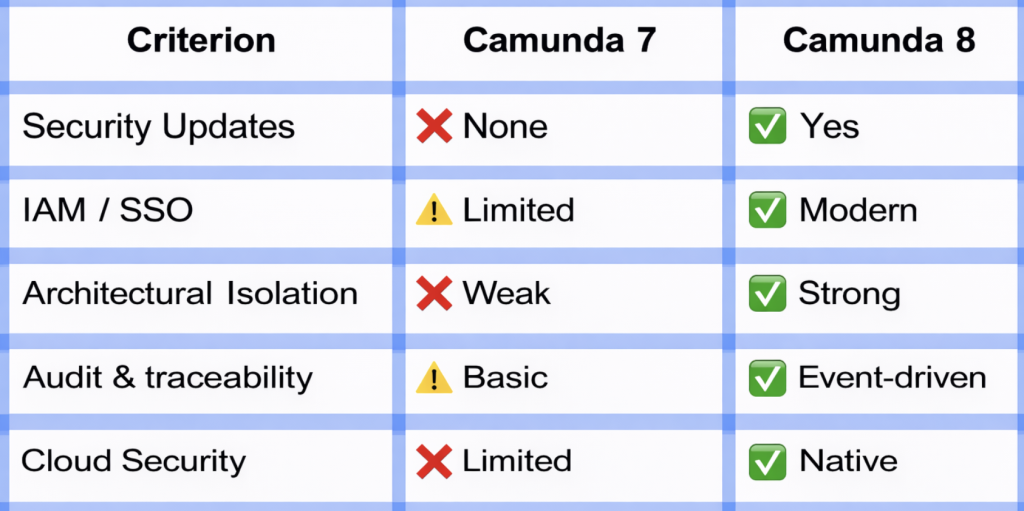
Safety Summary
Key Takeaway
From a security perspective, Camunda 7 in 2025 represents a manageable but aging risk.
Camunda 8, on the other hand, is a platform that aligns with modern enterprise security requirements and cloud-native architectures.
In practice, the security aspect is most often the decisive factor when banks, telecom companies, and large enterprise organizations choose Camunda 8.